Materials Can Be Found:
Demystifying AI: Your Five-Step Roadmap to Success
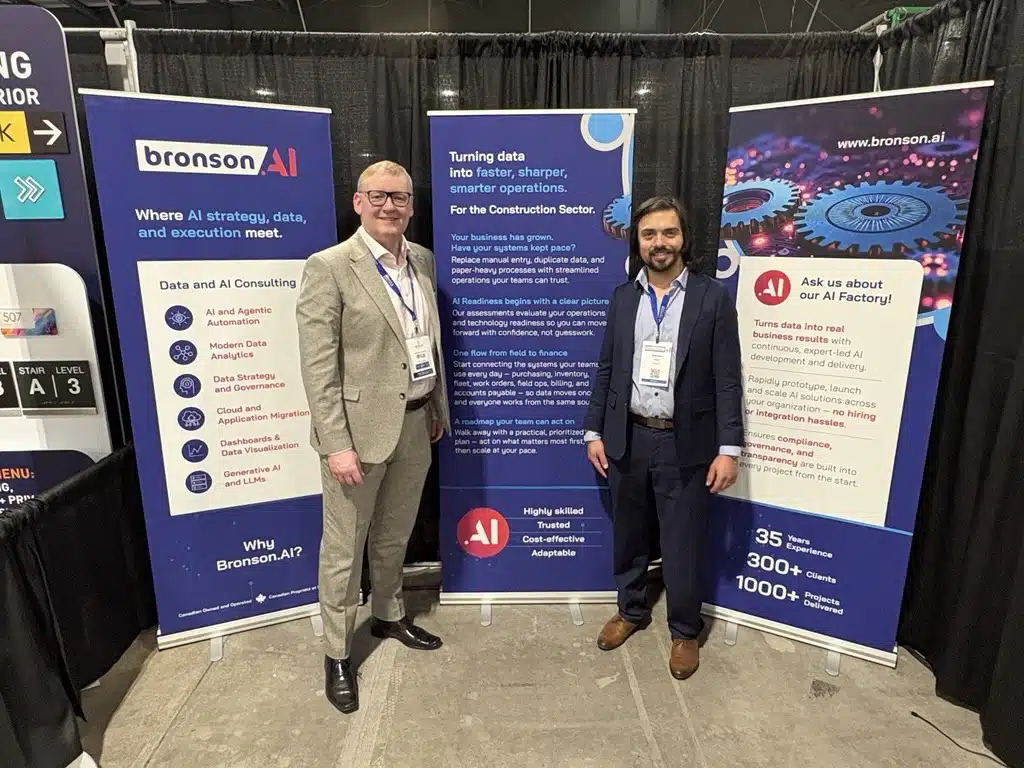
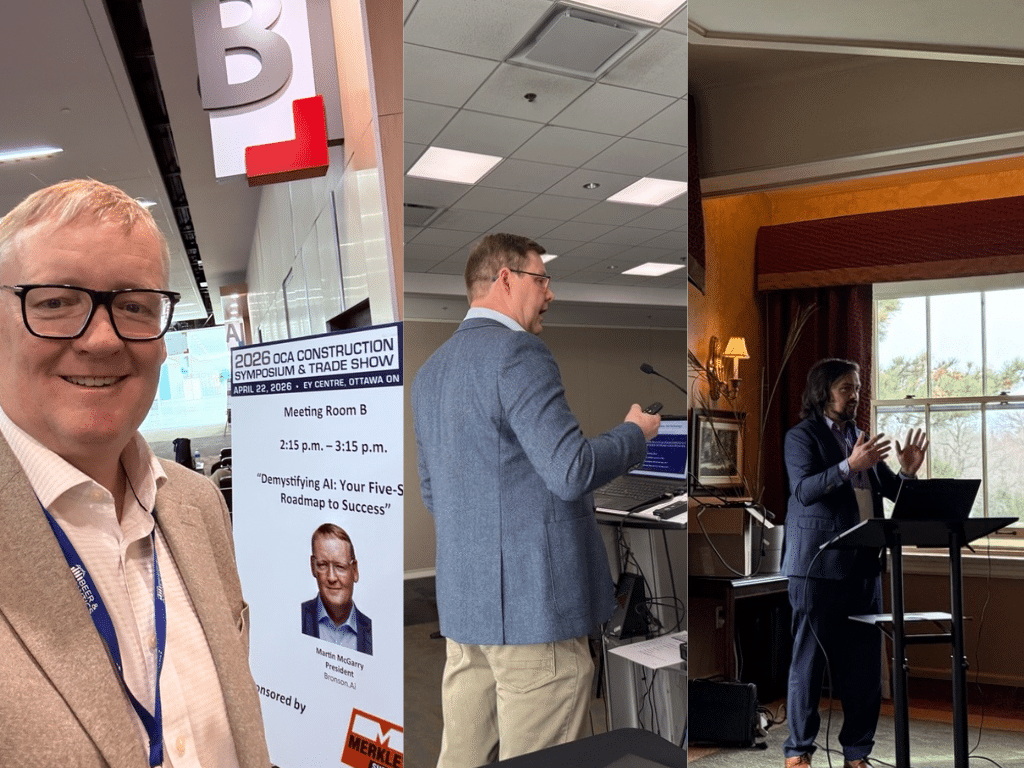
Bronson was pleased to present “Demystifying AI: Your Five-Step Roadmap to Success” at the sixth annual OCA Construction Symposium and Tradeshow, hosted by the Ottawa Construction Association at the EY Centre on Tuesday, April 22, 2026. Martin McGarry, Daniel Mixture, and Glendon Hass joined the Bronson delegation for a session aimed at builders, suppliers, designers, and purchasers, a practical look at how to move from AI curiosity to measurable results without a multi-million-dollar platform or a data science team.
The Bronson team opened by framing the moment. The window between “too early” and “too late” is open right now, the team argued, because the three constraints that historically held enterprise AI back have all collapsed: models are now capable enough to reason at expert level, affordable enough to run on a single API call, and accessible enough that internal teams can deploy without a PhD in machine learning. The question is no longer whether the technology is ready, it is whether the organization is.
Fewer than twenty percent of AI projects ever move to production, and the gap is not the technology, but rather, it is process and people. The session walked the audience through Bronson’s Five-Step Roadmap: start with the problem rather than the technology, audit your data against a “minimum viable data” standard, assemble the right four-person team, run a focused pilot in parallel with the existing process, and design the foundation so the second use case is cheaper than the first.
To make the roadmap concrete, the Bronson team walked through a recent engagement with a mid-size Canadian utility construction firm. Structured discovery across twelve departments surfaced roughly ninety improvement opportunities. The team selected the billing letter as the first pilot, finance was spending more than four hours a week manually keying data from fourteen-page PDFs into the accounting system and delivered a parsing engine that ran alongside the manual process for six weeks. The result: an approximately eighty percent reduction in billing processing time, an estimated two-to-five percent revenue recovery from previously missed service lines, and a data architecture and governance foundation designed to make the next use case faster than the first.
The session closed on what goes wrong. Most AI failures are not technology failures, they are process and expectation failures: starting with the technology rather than the pain point, treating AI as a one-time project rather than a programme, waiting for “perfect” data, and underestimating change management. The tool is twenty percent of the work; getting people to trust and use it is the other eighty.
Thank you to the Ottawa Construction Association for hosting, and to the members and exhibitors who joined the session. The full slide deck is available above.