Director, AI Adoption and the Future of Work, Bronson.AI
My career spans over 20 years of strategy, operations, innovation and transformation consulting across public and private sectors. Before joining Bronson, I co-founded an innovation lab for a global accounting firm and chaired the firm’s Global AI and Innovation committee. I have led the evaluation, pilot and rollout of OpenAI’s ChatGPT Enterprise for a multi-disciplinary organization of more than 5,000 professionals. To accompany this technology implementation, I designed and led a learning and development program for the Future of Work, connecting practical AI learning with the redesign of professional work. It’s been quite the ride, here at the dawn of the AI era, and in this report I’ll share some of my most important learnings.
I see AI as an opportunity to expand the potential of what people and organizations can accomplish: deeper analysis, better decisions and valuable work that cost and capacity constraints have kept out of reach. This has now become my mission, or what Peter Diamandis calls my “Massive Transformative Purpose”: to expand human potential by redesigning how people and teams think, decide and build in the age of AI.
My experience has taught me that realizing this potential takes more than capable tools. It takes leadership commitment, reliable data and individual development support that lets people discover new ways of putting their authentic expertise to work. This shouldn’t be viewed just as a technology implementation, but also a significant behavioural change. Teams must collaborate and come together to re-imagine and redesign their work in a way that is intentional. This report brings together Canadian research and a practitioner’s perspective on how to purposefully develop capable people, re-imagine how work flows and turn AI investments into measurable improvements.
Executive Summary
AI adoption is advancing. Is your organization keeping pace on results?
For medium-sized and large Canadian businesses, the strategic test is stronger operating performance and competitiveness. For government organizations, it is better service, sound decisions and greater capacity to deliver on their mandates.
International research gives business leaders reason to examine their progress. In KPMG’s first-quarter 2026 survey, 3% of Canadian respondents placed their organization at the stage of established returns from AI, compared with 8% across the global sample.8 Among mid-market companies already using AI, RSM found that 69% of Canadian respondents had partially or fully integrated it into their operations, compared with 89% in the United States.5 These are respondents’ own assessments. The practical question is what AI has helped your organization accomplish.
Use is climbing fast in Canada. Statistics Canada reported that 19.2% of businesses used AI to produce goods or deliver services in the year preceding its second-quarter 2026 survey.1 In a separate December 2025 Bank of Canada survey of 314 business leaders, approximately 70% reported personal AI use in a typical week, while 8% reported significant use in core business operations. The contrast within that group captures the challenge: individual usefulness and dependable organizational performance are different achievements.2
“Individual usefulness and dependable organizational performance are different achievements.”
For medium-sized and enterprise organizations, my own experience over the last 5 years points to developing broad organizational capability and technical readiness together in lock-step. Practical skills, reliable data and knowledge, appropriate systems, clear ownership and effective controls need to reinforce one another. This is a shared responsibility for operations, IT and business units. It is not a technology rollout to check boxes, be handed off and forgotten.3,4
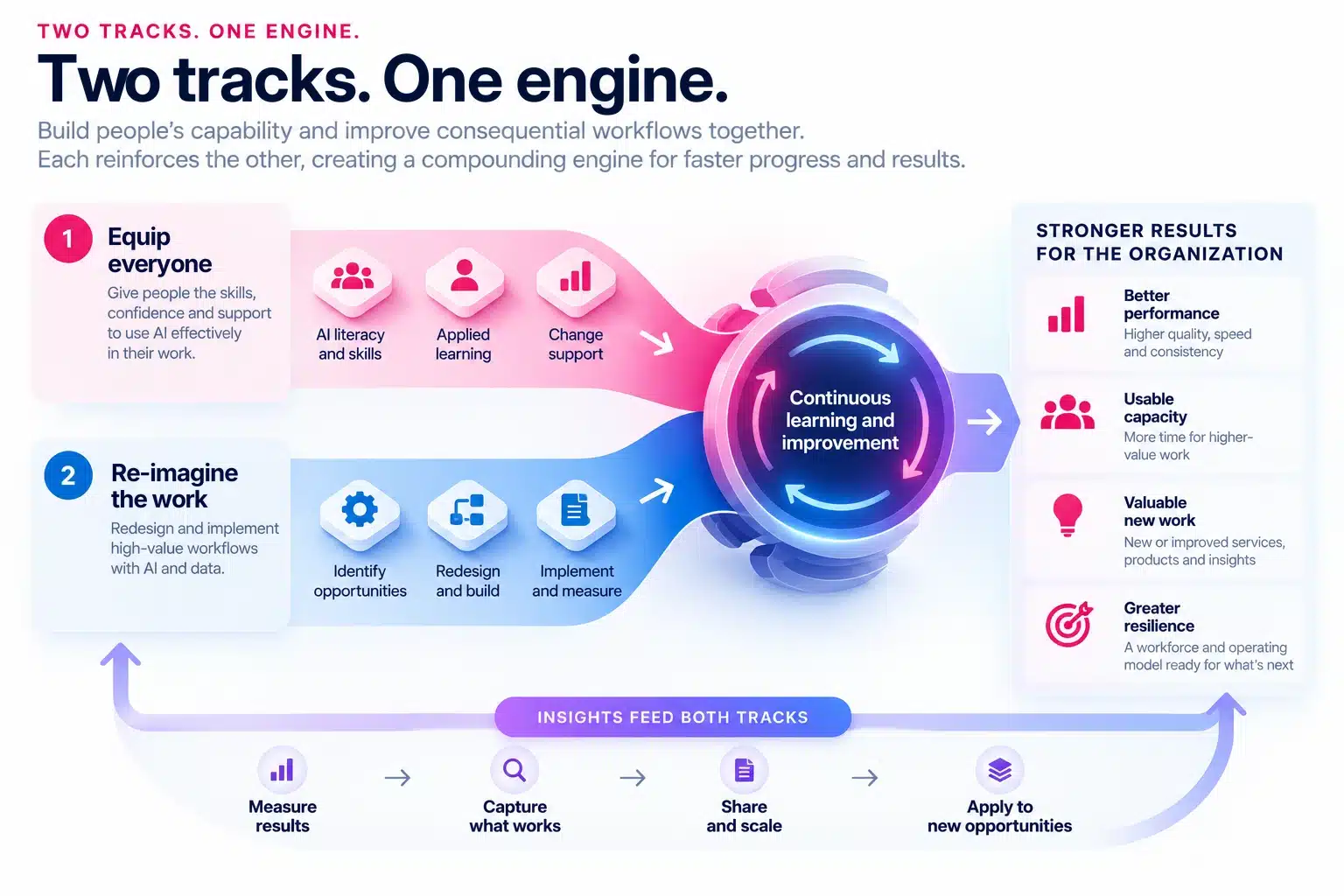
Turning AI adoption into organizational results takes two connected tracks: equipping people with the skills, confidence and support to use AI effectively, while redesigning high-value workflows with AI and data. The two reinforce each other through continuous learning and improvement—measuring results, capturing what works and applying those insights across both tracks. Together, they create a compounding engine for better performance, more capacity for higher-value work, valuable new services and greater resilience.
1
Equip everyone.
Capable tools, practical learning and room to experiment, across the entire workforce.
2
Re-imagine the work.
Redesign prioritized, consequential workflows end to end.
Each track fuels the other. Everyday use shows where the opportunities are, and redesigned workflows show the whole organization what good looks like. Together, they can turn scattered experiments into an organization-wide learning dynamic where improvements compound.
Four Priorities for the Executive Agenda
1
Build AI capability into the day-to-day work.
Employees need approved access to capable, current AI tools, practical learning and clear guidance. Give users and managers time to practise on real tasks, improve the way they work with AI tools and learn to understand limitations and recognize weak outputs. Capability shows up in the quality of the work, not in licences, token usage or training completions.
2
Start with the business metric, not the usage of AI.
Identify the business unit’s existing key performance indicators (KPIs): service turnaround, asset availability, margin or another outcome it already owns. Find the constraints, select workflows worth changing and give an operational owner authority to act. AI and agents are possible means of improvement, not objectives in themselves.
3
Measure where the value lands.
Recovered time is capacity, not yet value. Decide where it goes and count each benefit once: better existing work, faster or lower-cost delivery, or valuable new work. Judge each redesigned workflow by the business unit’s KPIs, after counting the full cost, including review and rework. Saved time becomes a budget saving only when spending goes down. For new work, determine how you will measure its value, leaning on existing KPIs.
4
Make quality and control part of the design.
A polished output that leaves colleagues to check and repair it can move effort rather than remove it. Set clear standards for accepted work. Match safeguards to the consequences of error, and define permissions, approval requirements and the ability to stop actions before delegating more to agents.
The opportunity is larger than doing the same tasks faster.
It is to make your organization more capable: better at the work it must deliver, ready for the pace clients and partners will come to expect, and able to take on valuable work that cost and capacity constraints have kept out of reach. Expansion should follow worthwhile results, not simply the availability of more licences.
That pace will not ease any time soon. Customer and client preferences are shifting faster than ever, and AI is accelerating both what they expect and how organizations can respond: processes keep evolving, and new markets, products and services keep opening up. Keeping up demands an organization that improves continuously.
Continuous improvement is not a new ambition. Lean Six Sigma, Total Quality Management and Kaizen made a compelling case for documenting how work runs and improving it steadily. These methods were sound, but in the real world? Ain’t nobody got time for that!
AI changes the equation, helping teams capture what they know, spot recurring problems and test improvements as part of the work rather than on top of it. The effect compounds: current knowledge and well-understood processes are exactly what AI and agentic systems need to deliver the next round of improvements. Further out, autonomous innovation may well be the next target.
The result of successful transformation is a more capable organization, built on teams and individuals with high agency: people who use AI with confidence and judgment, teams trusted to rethink how their work gets done, and leaders who can see what is working and back it. Progress no longer depends on a few early adopters; it becomes how the whole organization works.
This is our Triple A vision for the future of work: Adaptive, Augmented and Authentic: organizations that learn and evolve, extend human capability with AI, and create meaningful value for the people they serve.
This is where Bronson can help. Our approach connects workforce capability and workflow redesign with data, governance, analytics and AI delivery. The starting point is your operational priority, not a predetermined tool or vendor.
You do not need to arrive with an AI solution. Bring a business priority, a team and a performance measure you want to improve. Together, we can explore where to act, what your people and systems need, and what would justify the next investment.
Which result should your AI investment improve next?
About this report
This report draws on research available through October 2026, with a focus on medium-sized and large organizations in Canada, across the private sector and government. Canadian business and workforce surveys provide the national context, alongside international enterprise research and organizational examples. Business figures for organizations with 100 or more employees include both medium-sized and large employers; detailed source and methodology notes appear at the end.
- Section 1 sets out how quickly AI use is growing in Canada, how it varies by industry and where Canadian mid-market firms trail their US peers: in building AI into operations and proving the results.
- Section 2 distinguishes personal usefulness from organizational performance and asks where recovered time should go.
- Section 3 examines what real capability requires, from practical learning and capable tools to the judgment that stops polished but weak work from being passed along.
- Section 4 draws on Canadian examples from financial services, health care and the federal government, and shows how measures of success differ by business unit.
- Section 5 considers the technical readiness, governance and cost questions that determine whether AI can be relied on for consequential work.
- Section 6 turns these findings into a practical agenda for executive teams, built on running both tracks together.
- Section 7 explains how to become a learning organization in which improvements compound. The conclusion returns to our Triple A vision for the future of work.
Section 1
AI use is expanding, but national averages tell only part of the story
Statistics Canada reported that 19.2% of businesses used AI to produce goods or deliver services in the year preceding its second-quarter 2026 survey, compared with 6.1% in the corresponding 2024 survey. Among businesses with 100 or more employees, the 2026 estimate was 27.8%.1
Adoption varies sharply by industry. The figures below cover businesses of all sizes.
| Selected industry | Businesses reporting AI use, Q2 2026 |
|---|---|
| Information and cultural industries | 42.3% |
| Finance and insurance | 40.4% |
| Professional, scientific and technical services | 32.4% |
| Construction | 9.2% |
| Wholesale trade | 7.9% |
| Agriculture, forestry, fishing and hunting | 4.5% |
Source: Statistics Canada, second-quarter 2026 analysis; share of businesses reporting AI use.1
Choose comparisons that reflect the work your organization does. An insurer, manufacturer, hospital and government department face different opportunities, information needs and consequences of error. Check the survey behind a figure, too: research among executives already investing in AI describes a different part of the market from a national business survey. A useful benchmark helps you understand your own conditions, not simply whether you sit above or below an average.
In RSM’s 2026 survey of middle-market companies already using AI, 69% of Canadian respondents had partially or fully integrated AI into their operations, compared with 89% in the United States. Canadian respondents who had run pilots were less likely to say those pilots had defined goals and success criteria (42% vs. 57%), and Canadians were less likely to report that returns had exceeded expectations (43% vs. 57%).5 Canadian businesses are taking up AI.
“The work ahead is building AI into operations and proving the results to justify investment.”
Looking ahead, 25.2% of businesses planned to use AI during the following twelve months, according to the third-quarter 2026 Canadian Survey on Business Conditions. That signals an appetite to do more. The next challenge is turning those intentions into applications that earn their place in the work.6
Section 2
Personal usefulness and organizational performance are different measures
Statistics Canada found that 35.9% of workers aged 15 to 69 had used generative AI in their main job or business during the twelve months preceding its March 2026 survey. Most users were applying it selectively: 63.5% used it for some but not most tasks, while 11.6% used it for most or almost all tasks. For leaders, the useful question is where that assistance improves the work, and what people need to make it dependable.7
A Bank of Canada survey of 314 business leaders in December 2025 offers another view. Approximately 70% reported using AI personally in a typical week, while only 8% reported significant use in core business operations. Within that group, AI was already part of many leaders’ working lives, but much less embedded in how their businesses operated.2
The distinction also appears in international research. In McKinsey’s 2026 global survey, 80% of respondents reported improved individual productivity, while 37% reported a positive impact on organizational earnings before interest and taxes. Personal usefulness and business performance are different achievements; leaders need to pay attention to both.3
At a glance · personal use and organizational results
Bank of Canada · 314 business leaders · December 2025
McKinsey · global survey · 2026
Self-reported survey results from two different samples; not directly comparable.2,3
KPMG’s first-quarter 2026 Global AI Pulse survey adds an international comparison. Among 306 Canadian executives at companies with annual revenues of at least $50 million, 70% said AI was delivering meaningful business value, yet only 3% placed their organization at the stage of established returns from AI, compared with 8% across the global sample. This measures how executives describe their organization’s progress; it does not establish audited financial returns. The leadership task is to make value concrete: which outcome improved, by how much and at what cost?8
For my friends in government organizations and adjacent agencies, the corresponding management task is to define and demonstrate public-service outcomes: timely service, reliable decisions, manageable workloads and effective delivery of the mandate. These survey results provide context for the implementation challenge, rather than a performance benchmark in the public context.
Time savings matter, even before they appear in financial results. A randomized study across 66 firms and 7,137 workers estimated that users of an integrated generative-AI tool spent about two fewer hours per week on email, without a detectable change in the quantity or composition of the tasks measured. Releasing time is a useful first step; deciding how to put it to work is a management choice.9
Individual gains are valuable in their own right. Not every useful application needs to become an integrated or automated workflow. Give employees opportunities to prepare, analyse, explore alternatives and improve their everyday work while larger process changes proceed alongside them. Look for improvements that last, rather than assuming an encouraging first experience will be enough.
Example
Consider a team preparing reporting materials. AI may shorten the initial draft substantially or help the author examine more alternatives. Yet the overall process may remain slow because information is difficult to locate, reviewers have conflicting requirements, or approvals accumulate between teams. Improving the individual task is useful; improving the full process requires additional decisions. The organization can pursue both without making one a prerequisite for the other.
Ask two sets of questions, one for each track. Are employees able to use approved tools confidently, exercise sound judgment and produce better work? Are redesigned workflows improving the business unit’s outcomes, with effective handoffs, review and controls? Tracking both helps connect everyday experience with wider organizational progress.
The destination also matters. Recovered time is capacity, not yet value. It might improve existing work, speed delivery, reduce overtime or make room for valuable new work. It becomes a budget saving only when spending goes down. The organization needs to explain where the time went and what improved as a result.
I often ask a room whether anyone has ever reached the end of their to-do list in a day. Not one person, in any role, has ever said yes. Recovered time will always find a use; left unmanaged, it goes to whatever is most urgent, which is not always what matters most. Work deferred because of capacity constraints might include deeper analysis, proactive client follow-up and maintaining institutional knowledge. At Bronson, we recommend making these opportunities visible and deciding which deserve attention: the list may be endless, but people’s time and energy are not.
It’s also important to take a step back and recognize that there is valuable work that has never made a person’s to-do list. Ideas such as entering an adjacent market, developing a related offer or reviewing every file rather than a sample may be well understood, yet never seriously considered because it has always cost too much money, time or effort to be worthwhile. Where AI lowers the cost of analysis, drafting or translation, for example, that calculation can change. Bring them into scope: revisit ideas once set aside as too costly and test the most promising in small steps, each with a clear point to continue or stop. Additional output is not automatically additional value; its quality, usefulness and ongoing cost still need to be assessed.
Section 3
Capability means being able to use, judge and improve the work
Training must translate into practical capability
Among Canadian businesses using AI, 32.0% said they had trained existing employees. Among AI-using employers with 100 or more employees, 68.1% reported employee training and 51.7% reported executive training. Those activities are a useful starting point. The real test is how well people can apply the learning.1
Employees are asking for more support. In KPMG’s August 2025 survey of 2,239 Canadian employees, 83% wanted or needed to learn to use generative AI more effectively, while only 48% felt their employer had provided the training and guidance needed to improve productivity in their role. Ask whether your learning program is helping people with the work in front of them, not just introducing them to the technology.10
That means looking beyond whether training has occurred.
- Can employees apply what they learned to real work?
- Can reviewers spot unsupported statements, inappropriate recommendations or missing information?
- Does the team know when another method would be better?
My test for a client learning program is simple: what will people do differently at work the following week? Build practice around real tasks and decisions.
- Customer-service teams: Rehearse a difficult complaint. Explore responses with AI, then spot where a polished answer promises something the organization cannot deliver.
- Analysts: Investigate a sudden margin drop. Use AI to test competing explanations, then check the numbers before recommending action.
- Corporate services teams: Investigate why a routine purchase takes weeks. Use AI to map the handoffs and challenge duplicate approvals, then check proposed changes against procurement controls.
Adult humans learn by doing, and real practice should lead to work that a knowledgeable reviewer can stand behind.
Capable tools, useful context and ongoing practice
Employees need opportunities to practise with leading AI assistants in a secure work environment where they can understand limitations and develop judgment through experience.
An approved environment combines tools suited to the work with clear rules about what employees may enter, connect and share. Choose the deployment, permissions and data-handling arrangements to fit the organization’s information and obligations. Make the responsible path practical enough that people can use it in their everyday work.
Keep the approved environment current by testing tools against real work, not simply selecting the newest model. Consider the experience around the model too: can employees preserve useful context, refine instructions and build on earlier work without starting again each time?
Practice becomes more useful when the assistant does not start from scratch each time. Memory features in ChatGPT and Claude can carry preferences and relevant context forward, and project instructions and reference files help shape the work.11,12,13 Used well, they bring a first draft closer to the employee’s audience, style and purpose. Help employees build that context within the organization’s information rules, and preserve useful instructions, examples and workflows when tools change rather than making people start over.
Practical development should also go beyond producing a faster first draft. Employees can practise framing a problem, asking the system to explore alternatives, testing its reasoning against evidence and deciding what to accept. In this form of human–AI collaboration, people remain responsible for the purpose, judgment and quality of the work. Managers need time and support for this learning, as well as clear expectations for its application.
Enthusiasm at the top may look different from the experience of implementation. BCG’s global AI Radar 2026 survey found confidence in AI’s eventual payoff among 62% of CEOs, compared with just 48% of non-technology executives outside the C-suite. Ask managers what would help them deliver and what is getting in the way. Their answers should shape the program, not simply be treated as resistance to it.14
Avoid the “slop grenade”
AI can make weak work look finished. A “slop grenade” is polished output that leaves the recipient to do the real work: interpreting, correcting or redoing it. BetterUp Labs and Stanford Social Media Lab call this “workslop.” In their survey of nearly 2,300 full-time workers and leaders in the United States, Canada and the United Kingdom, 44% of Canadian desk workers reported receiving workslop from a colleague in the previous month, and 55% admitted to sending it themselves.15
The cost goes beyond the time it takes to fix. Around half of those surveyed saw a colleague who sent workslop as less creative, capable and reliable, and 42% saw them as less trustworthy. The researchers trace the problem to working conditions rather than the technology: blanket mandates to use AI, overloaded employees and eroding trust. BetterUp reports that trust within teams cut workslop by 61%. Mandating use without time and support rewards visible activity over useful work, which is one more reason to judge AI by the quality of accepted work rather than by usage.15
Workflow ownership connects capability to results
Workflow redesign stands out in McKinsey’s global survey: nearly three-quarters of its AI high performers had fundamentally redesigned workflows, compared with roughly one-quarter of other respondents. That pattern is a useful reminder to look beyond the tool. Examine the process around it, including how information moves, how decisions are made and how work is accepted.3
Bain makes a similar management argument in The AI Enterprise: Code Red: develop workforce capability and redesign workflows in parallel. Its recommendations connect human accountability, preparation for working with agents, and performance against defined KPIs. Skilled people need processes that let them put their capability to use; redesigned processes need people ready to operate them.4
Put an operational owner in charge of the relevant business-unit outcome, with authority to change the process and assess the results. Technology teams should take responsibility for reliable systems and appropriate access. Bring employees who perform the work into the design: they know where exceptions, unnecessary steps and practical constraints arise.
Section 4
Canadian examples show different forms of adoption
Canadian organizations are approaching AI in different ways, from supporting financial advisers to helping clinical teams respond and building shared government tools. Each approach brings its own management questions about how access and capability translate into better work.
Financial services: supporting advisers within an approved environment
In April 2026, RBC Wealth Management reported that all its Canadian wealth advisers had been onboarded to RBC Assist, its in-house generative AI tool for improving productivity and efficiency.17 Access is the first step; the test is what it does for the client relationship. A comparable initiative could track preparation time, the accuracy of retrieved information, the correction required and the quality of the client interaction, connecting an employee-facing tool to the service it is meant to improve.
Health care: connecting a prediction to a clinical response
Unity Health Toronto describes CHARTWatch as an early-warning system that identifies hospitalized patients at risk of deterioration and alerts doctors and nurses so they can intervene. Its December 2025 account also describes the Health AI Academy, which combines foundational learning with practical development for health leaders.18
The example illustrates an important design principle: a prediction has to lead to an appropriate response. Evaluation should consider not only the model’s performance, but also who receives an alert, what action follows, whether staff can respond and how the intervention affects care. Those questions are different from counting how often a tool is opened.
Federal government: separating activity, rollout plans and service outcomes
The federal AI strategy’s progress reporting describes ESDC’s EVA Chat pilot serving more than 13,000 employees and handling more than two million prompts in its first year. GCtranslate’s first rollout phase, which began in April 2026, is set to reach 43 institutions and approximately 270,000 users. Together, the pilot activity and planned reach give a sense of the scale of federal implementation.19
For departments, the next step is connecting implementation to service: better quality, shorter waits, manageable staff workloads and a clear account of costs. Usage helps show where a tool has taken hold; service measures help explain what it contributes.
Shared platforms offer opportunities to reuse what works, but departments still differ in mandate, information sensitivity, legacy systems and service complexity. Reuse the learning while adapting the implementation to the service.
Different teams, different measures of success
Measures of success vary by team and business unit, even within the same industry. My starting point with clients is the outcome their team already owns, not an AI application in search of a purpose. Identify the unit’s existing KPIs, establish current performance and examine what is holding it back. Then assess whether AI, agentic AI or a broader redesign of the work can address those constraints.
The table below offers illustrative starting points for sample business units. Each business unit will need to adapt them to their own KPI definitions, priorities and constraints.
| Business unit or function | Illustrative business KPIs to start from | Possible workflow opportunities |
|---|---|---|
| Manufacturing and natural resources operations | Asset availability, maintenance cost and defect rates | Maintenance planning or inspection support |
| Transportation and logistics operations | On-time delivery, cost per delivery and safety performance | Disruption analysis and dispatch support |
| Retail and wholesale inventory teams | Stock availability, waste and gross margin | Demand forecasting and inventory decisions |
| Professional and business services delivery teams | Client satisfaction, on-time delivery and project margin | Research, document review and client deliverables |
| Public administration service teams | Service turnaround, cost per completed case and service accessibility | Document intake and case preparation |
Task-level measures such as preparation time, forecast error, false alarms and rework help explain how a change contributes. They should not automatically substitute for the unit’s business KPIs. Quicker case preparation, for example, may have little effect on service turnaround if the main bottleneck remains approval.
Judge the change against the business KPIs, while accounting for other developments that may affect performance. Keep quality, safety, privacy, compliance and employee workload in view. A better number should represent a better outcome, not a problem shifted elsewhere in the process.
Section 5
Technical readiness and governance remain material constraints
AI has to work within the technology environment an organization already has. The Treasury Board of Canada’s 2026–27 Departmental Plan reported that 38% of federal business applications were assessed as healthy in 2024–25. For leaders, that is a reminder to examine the systems an AI-enabled workflow will depend on, alongside the tool itself.20
For a proposed workflow, leaders should ask whether the necessary information is accurate, current and accessible to the right people. They should also establish whether the surrounding systems can support dependable operation. An assistant connected to conflicting policy documents may retrieve an answer quickly while leaving the underlying information problem unresolved.
This does not mean every organization must complete a major data-platform transformation before using AI. A given application may need only a carefully maintained set of approved documents. A system spanning several operational platforms may require substantial integration. The appropriate investment follows from the use case and its risks.
Keep workforce enablement moving where the approved environment can support it, while integration work continues alongside. Budget for safeguards, support and learning as well as access.
Governance should reflect key decision points and their consequences
Across public and private sectors, governance should begin with a risk-based assessment of the key decisions across consequential workflows: what information is used, which decisions are fundamentally influenced by a change, who could be affected and what would happen if the wrong decision was made?
The controls should match AI’s role in the workflow—whether it helps someone complete a task, shapes a consequential decision or takes action directly. Legal and regulatory requirements will vary by institution, sector and jurisdiction. In every case, the practical goal is the same: set clear limits on what AI can do, define where human review or approval is required and make accountability explicit.
Public-sector example
Deciding who gets a benefit. Imagine AI recommending whether an applicant qualifies for a government benefit. An employee makes the final call, but the AI has helped shape a decision that affects someone’s livelihood. In federal departments, this kind of use can fall under the Directive on Automated Decision-Making; a human sign-off alone does not remove it from the directive’s scope.21 The practical priority is meaningful review: staff should be able to check the recommendation, explain the decision and correct mistakes, not simply approve what the system suggests.
Private-sector example
Insurance claims. An insurer might use AI to help staff find approved policy wording or to shape a decision around a customer’s claim. Both uses require controls to protect customer information and keep policy content accurate and current. But a decision about payment can directly affect the customer, so it needs stronger safeguards: a qualified person who checks the evidence and can reject the AI-recommended decision, a clear route for the customer to challenge the outcome, and a process to correct errors. Keep enough of a record to explain the decision and investigate what went wrong.
In either sector, make governance part of how the work runs. Organizations with limited process documentation may find that implementing AI exposes gaps they have long worked around: unclear decision rules, informal handoffs and critical knowledge held by a few experienced people. Those gaps need to be understood and addressed before AI is trusted to carry out or influence the work. Before launch, decide what information the system may access, what it may produce or change, who reviews consequential outputs, what records are retained and how errors can be corrected. Revisit and test those arrangements as the workflow evolves, rather than leaving them in a policy document.
Agentic AI increases the importance of clear authority
Systems that can take actions across tools introduce a different management problem from systems that only suggest an answer. The organization must determine what authority is being delegated and how that authority can be limited or withdrawn.
In Deloitte’s 2026 global survey of organizations already active in AI, only 23% reported at least moderate use of agentic AI, while 74% expected to reach that level within two years. Only 21% reported mature governance for autonomous agents. The survey, conducted in August and September 2025, captures strong ambitions for expansion alongside a substantial control challenge.22
In KPMG’s 2026 survey of 306 Canadian executives, 77% reported agents assisting with tasks such as sharing knowledge between departments. Definitions vary, so look past the label: what can the agent do, what authority has it been given, and who can intervene?8
Increase autonomy as a workflow demonstrates dependable performance under defined conditions. Set permissions, spending limits, approval requirements and monitoring before delegating more. Make sure people can stop inappropriate actions and reverse them where possible.
The business case needs the full cost of delivery
In Accenture’s September 2026 research at global enterprises with more than US$1 billion in annual revenue, only 35% of surveyed companies could calculate cost per business outcome for even their largest AI use cases. Work on building this financial visibility early, while the initiative is still small enough to understand.23
For an individual initiative, a useful measure is cost per accepted result. That includes licences and model consumption, but also integration, data preparation, employee time, review, correction, monitoring and maintenance. A faster initial answer may be more expensive overall if it creates substantial downstream verification.
Equally, an application may justify its cost through better service, reduced risk or valuable new work rather than direct labour savings. The business case should state where the value is expected to land and how it will be assessed.
Section 6
A practical agenda for executive teams
Our advice to executive teams is to run both tracks together: equip everyone and re-imagine the work. Give each the ownership and support it needs, with shared expectations for responsible use, learning and results.
| Track | Purpose | Management approach |
|---|---|---|
| Equip everyone Broad workforce enablement | Help employees learn, exercise judgment and improve their everyday work with AI | Approved tools, practical learning, clear boundaries, support and room to experiment |
| Re-imagine the work Targeted workflow transformation | Improve business-unit outcomes by redesigning consequential processes, with integration, automation or agents where appropriate | Existing KPIs, operational ownership, baselines, technical controls and evaluation of the complete process |
The steps below put the two tracks and four priorities into practice.
Enable the workforce broadly, within clear boundaries
Provide employees with approved access to capable, current AI tools suited to their roles and information requirements. Establish practical rules for appropriate use, review and escalation. Assign responsibility for the enablement program, including tool selection, access, learning, support and ongoing costs.
Roll out access in a way that reflects role and risk, rather than assuming every employee needs identical tools or permissions. Give people time to practise and managers support to guide that practice. Broad enablement need not wait for all integration projects to be completed, but it should not bypass the safeguards required for the work.
The objective is people who use AI with confidence and judgment, not simply more licences. Look for evidence in the work: better quality, less correction and appropriate use.
Start with business-unit outcomes and redesign the work
In parallel with workforce enablement, identify the existing KPIs a business unit needs to improve. Establish current performance, agree on the intended improvement and investigate the constraints. Then select a small number of consequential workflows where a change could contribute to those outcomes. Describe the users, information requirements, work volumes and consequences of error. Establish why AI is a reasonable option, rather than assuming every performance problem requires it.
Name an operational owner accountable for the relevant outcome and for evaluating the redesign’s contribution, with authority to change the process rather than simply sponsor the technology. Bring together the people who perform the work, technical specialists and the relevant risk, finance and workforce functions. Agree on the KPI definitions, responsibilities and safeguards, including who accepts outputs, handles exceptions and approves changes.
Redesign may involve better information access, handoffs or review rather than automation. The relevant question is whether the process works better, not how much human involvement has been removed. Consider AI and agentic AI as possible means of addressing the constraints, not as objectives in themselves. Use agents only where delegated action is appropriate and the necessary controls can be demonstrated.
Build capability into the day-to-day work and connect the two tracks
Build learning around representative tasks, including ambiguous cases and plausible but incorrect outputs. Help employees practise problem framing, exploration, verification and judgment, not just prompting. Give managers the same opportunity to practise evaluation as employees have to practise production. Refresh guidance as approved tools and working practices change.
Invite staff to identify valuable uses, extra verification work and unresolved constraints. Give these observations a route to operational owners, who can decide whether an idea merits further investigation, process redesign or no additional investment. Share lessons from evaluated workflow changes back into the broader learning program.
A process for reporting problems should make improvement easier, rather than make people reluctant to disclose a disappointing result. Exploration should remain bounded by the organization’s information rules and the consequences of error.
Test complete workflows, with quality and control built in
For integrated applications, evaluate the model, data, handoffs, review process and technical controls together against the agreed KPI objectives and safeguards. Test failure handling and the route back to the previous process. Define the conditions under which the initiative should be revised, paused or stopped. For agents, test triggers, permissions, approval requirements, monitoring and the ability to stop or reverse actions before broader delegation.
Stopping an unsuitable application can be a sound outcome. The purpose of a pilot is to inform a decision, not to create an obligation to scale. Likewise, expanding approved employee access does not authorize every use of a tool; consequential applications may still need separate review.
Decide where capacity goes and measure where the value lands
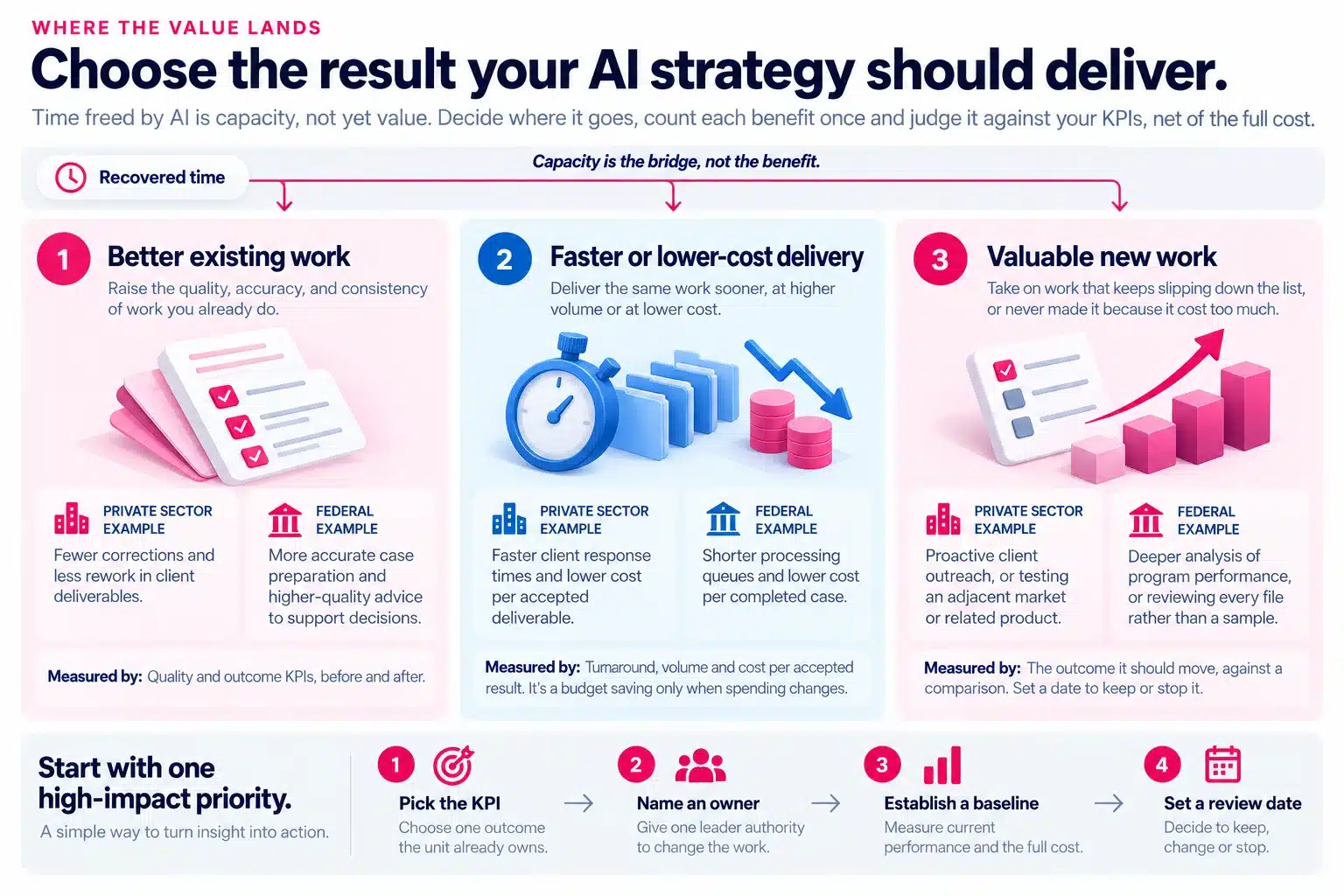
Match the measures to the benefit you are trying to achieve. Track business outcomes through the unit’s KPIs, use workflow measures to understand how the change works, and maintain safeguards for quality, safety, privacy, compliance and employee workload. Faster tasks are useful, but the business result is what tells you whether the redesign is worth expanding. I am regularly surprised by how few teams maintain current metrics on workflow performance.
Establish the baseline, intended KPI improvement and review period before implementation. Follow the complete process, including handoffs, review, rework and total cost, not just the time saved producing a draft. A comparison group or phased rollout can help separate the redesign’s contribution from changes in demand, staffing or policy. Explain the result in the context of what else changed.
Expect the bar to keep rising. Customer and client preferences are shifting faster than ever, and as AI accelerates work across workflows and supply chains, clients and partners will come to expect more, faster. Their own use of AI can also increase the volume of requests, applications and submissions you receive. Some returns will look like standing still: service standards held as volumes rise, or clients retained as expectations change. Compare results with what would otherwise have happened, not only with the starting baseline, and plan for extra volume where work is most likely to queue, such as review and approval.
Start with existing KPIs and add measures where they miss an important benefit or risk. For employee enablement, connect gains in representative tasks to team outcomes where practical, while preserving room to learn and explore.
With clients, I help them explore what recovered capacity will make possible, not just how many hours were saved. Decide where that capacity should go, then track what happens: shorter waits, less overtime, better quality, additional work or budget savings. Bring valuable tasks that have long been deferred into that conversation, along with ideas once set aside because they were too costly. When AI makes new work possible, judge it against the outcome it should move, often an existing KPI, and its full cost, rather than a productivity baseline for work that was never previously done. Set a date to keep or stop it.
Count the full cost per accepted result, not just licences and model consumption. Report usage alongside results, not in place of them, and avoid counting the same benefit twice across the two tracks.
Once an approach demonstrates worthwhile results, capture what another team would need to reproduce it. Expansion should follow evidence and readiness, while continued learning helps the organization identify its next opportunities.
Section 7
Become a learning organization
In The Fifth Discipline, Peter Senge describes learning organizations as places “where people continually expand their capacity to create the results they truly desire.” In practical terms, this means more than training individuals: it means developing both people and AI systems to learn together, question established assumptions and turn what they discover into better ways of working.
Building that capacity is part of the hard work that all organizations are going to need to undertake to address AI transformation. People need ways to turn experience into better judgment, better information and better workflows. With humans collaborating with AI as a matter of everyday work, that means using feedback to improve the next round of work. That is how agency spreads: people who notice what could work better have the skills, permission and support to act on it, and their teams learn from the result.
Make each implementation useful to the next round of work. Turn findings into better instructions, approved reference material, review standards and workflow design. Check whether those changes improve quality, rework or the unit’s KPIs before scaling them. When results disappoint, question the process and its assumptions, not just the prompt. Share lessons from AI integrations that were paused or stopped as well as those that succeeded.
Keep organizational knowledge current. Where a process is undocumented, capture how work actually runs, including exceptions and the reasoning behind important decisions. Keep it in a shared, approved source, with an owner responsible for updates as the process changes. AI can help prepare and maintain documentation; people who know the work should validate it. Keeping that knowledge current is also valuable work that newly available capacity can make possible, especially where process documentation has long been deferred.
Make continuous improvement sustainable. Lean Six Sigma, Total Quality Management and Kaizen showed the value of documenting how work runs and improving it in small, steady steps. Many organizations struggled to sustain them alongside the day job. AI can lower that cost, helping teams capture current practice, identify recurring problems, and draft and test changes as part of the work. The benefit compounds: current, well-documented processes give AI assistants and agents better context, which makes the next improvement easier to find and safer to implement.
Look ahead to autonomous innovation. The same logic is starting to reach what organizations offer, not just how they work. Board of Innovation describes AI agents that scan market, social and scientific signals, generate product and service concepts, and test them for desirability, feasibility and viability, often against simulated customers, before anything is built. It reports producing more than 200 concepts for a global construction company in three days, and says the bottleneck is organizational change, not technology.24 These are a consultancy’s own claims, of course, and simulated customers are no substitute for real ones. The direction still matters: when ideas become cheap, the scarce capabilities are judgment about which fit the strategy, the capacity to test and launch them quickly, and clear limits on what agents may decide alone. That is high agency, applied to what the organization offers next.
Conclusion
The next chapter of Canadian AI adoption is about building more capable organizations: people who work with AI confidently and with sound judgment, teams with the authority to re-imagine their work, and organizations that compound what they learn. Getting there takes leadership on both tracks at once: equipping everyone, and re-imagining the processes that shape business and service outcomes.
Operations, technology and workforce leaders need to bring these elements together: capable people, reliable information, appropriate systems, well-designed processes and effective controls. They also need to decide where recovered capacity goes and measure where the value lands.
Canada’s AI opportunity reaches beyond productivity. It is a chance to build stronger businesses, more responsive public services and working lives with greater room for human creativity, judgment and ingenuity. Realizing it will take organizations that learn as fast as their customers and clients change, and leaders willing to re-imagine the work.
The ambition is not simply to do today’s work faster. It is to expand what people and organizations are capable of achieving—and turn that capability into better outcomes for the people they serve. That will take leaders willing to invest in their people, challenge established ways of working and take responsibility for results. The future of work is ours to shape with intention and purpose. The work of building it starts now.
Which result should your AI adoption strategy improve next?
Bring an operational priority, a team and a performance measure you want to improve. Bronson can help you examine what your people, information and workflows need, and what evidence would justify the next investment.
Discuss your next AI priority with BronsonSources and research notes
[1] Statistics Canada. Analysis on artificial intelligence use by businesses in Canada, second quarter of 2026, 11 June 2026. Government-funded, stratified survey of business establishments with employees; fieldwork 1 April–6 May 2026; 21,105 sampled and 9,251 responses. Figures cited are weighted estimates; AI-use questions refer to the preceding twelve months. See printed pages 4, 6 and 7.
[2] Chanya Chawla and Crystal Arnburg, Bank of Canada. Survey Evidence on Firm AI Adoption and its Implications, Staff Analytical Paper 2026-22, June 2026. Publicly funded research using special questions in the December 2025 Business Leaders’ Pulse survey; 314 responses. The sampling approach does not support population-representative estimates of all Canadian firms. See printed pages 1–3, including Chart 2.
[3] McKinsey. The state of AI in 2026: On the road to ROI, 25 August 2026. Consulting-sponsored global survey of 1,719 respondents in 97 countries, fielded 4 May–8 June 2026. Findings are self-reported and observational; the report’s high-performer classification is not a general definition of successful AI adoption.
[4] Bain & Company. The AI Enterprise: Code Red, 25 February 2026. Consulting-authored strategic guidance on parallel workforce and workflow modernization, human–agent teams, governance and KPI-based performance management. Used as an advisory perspective, not a representative survey or independently evaluated claim of impact.
[5] RSM. Canadian firms embrace AI, but trail U.S. in integration and ROI, RSM survey finds, 21 July 2026; and Key AI report findings for Canadian businesses. Consulting-sponsored RSM Middle Market AI Survey 2026: U.S. and Canada, fielded 5–16 March 2026 among 1,030 mid-level or more senior managers with influence over technology investment (827 in the United States, 203 in Canada), from a Big Village Insights sample. Middle market is defined as annual revenue of $30 million to $1 billion in Canada and $30 million to $10 billion in the United States, excluding government and nonprofit organizations. All respondents’ organizations already use AI, so the figures describe depth of use among adopters, not adoption rates. The stated ±3.1-point margin of error applies to the full sample; the Canadian subsample is smaller and less precise. Pilot findings refer to respondents who ran AI pilots in the previous 24 months. Findings are self-reported.
[6] Statistics Canada. Canadian Survey on Business Conditions, third quarter of 2026, 31 August 2026. Official business-survey reporting. Plans concern future use, not completed adoption. The release also identifies the end of this survey programme.
[7] Statistics Canada. Use of generative artificial intelligence tools among Canadian workers, March 2026, 30 July 2026. Government-funded March 2026 Labour Force Survey supplement covering respondents aged 15 to 69 living in the provinces, with the stated survey exclusions. The release does not specify the supplement’s respondent count. Estimates concern self-reported use in the main job or business during the preceding twelve months; task breadth is reported among users.
[8] KPMG in Canada and KPMG International. Canadian business leaders expect agentic AI to reshape the workforce, 6 May 2026; The agentic shift: AI’s next phase; and Global AI Pulse Q1 2026, April 2026, printed pages 10 and 40. Consulting-sponsored online survey of 2,110 executives across 20 markets, including 306 Canadian respondents. The Canadian release gives 19 February–27 March 2026 fieldwork and company revenues from $50 million; the global report gives 19 February–17 March and a US$100 million minimum. These published differences limit comparability and are not reconciled here. The 3% Canadian and 8% global figures refer to the self-selected stage “Established return on investment (meaningful business outcomes).” They are not audited returns, a national success rate or proof that other respondents received no benefit. Revenue bands are not employee-count segments. The global sample includes Canada. The comparison uses Q1 figures for both groups.
[9] Eleanor W. Dillon, Sonia Jaffe, Nicole Immorlica and Christopher T. Stanton. Shifting Work Patterns with Generative AI, NBER Working Paper 33795, May 2025, revised November 2025. Randomized access to an integrated AI tool across 66 firms and 7,137 workers. Microsoft-affiliated researchers participated. The approximately two-hour email estimate concerns users; the study does not establish enterprise-wide financial returns.
[10] KPMG in Canada. Canadian employees call for clear and transparent AI policies as adoption grows, 27 November 2025, reporting the Generative AI Adoption Index Survey. Consulting-sponsored online survey of 2,239 Canadian employees aged 18 and older, conducted 15–29 August 2025 using Sago’s Methodify platform. The cited training findings are employee perceptions, not proficiency assessments or matched comparisons with employer responses.
[11] OpenAI. Memory and new controls for ChatGPT, 13 February 2024, with subsequent feature and availability updates. Vendor documentation of saved preferences, relevant context and memory controls. Availability depends on plan and settings; the source describes capabilities, not independently measured productivity gains.
[12] Anthropic. Bringing memory to Claude, 11 September 2025, updated 23 October 2025. Vendor documentation of memory, project context and user controls. Availability and scope depend on plan and settings; the source describes capabilities, not independently measured productivity gains.
[13] OpenAI. Projects in ChatGPT, Help Centre documentation. Describes project instructions, reference files, context and workspace controls. Features depend on plan and settings; the source documents capabilities rather than independently measured productivity gains.
[14] Boston Consulting Group. As AI Investments Surge, CEOs Take the Lead — BCG AI Radar 2026, 15 January 2026. Consulting-sponsored global survey of nearly 2,400 executives, including 640 CEOs, across 16 markets. The article does not specify fieldwork dates. The cited confidence figures compare executive groups; they are not Canadian estimates, paired employer–employee data or evidence that confidence causes better outcomes.
[15] Marielle Leon, BetterUp. Workslop: What Canadian leaders need to know, 18 May 2026. Vendor account of research by BetterUp Labs and Stanford Social Media Lab surveying nearly 2,300 full-time workers and leaders across the United States, Canada and the United Kingdom, September 2025–March 2026. It is not a standalone Canadian study: the 44% and 55% figures describe the survey’s Canadian desk workers, and the article does not give subgroup size, weighting or full methodology, so they are not treated as national prevalence estimates. Perception and trust findings are not identified as Canadian results. An earlier BetterUp Labs and Stanford survey of 1,150 full-time US desk workers introduced the term in Harvard Business Review in September 2025 (BetterUp Labs). Findings are self-reported; BetterUp sells coaching and workforce-development services.
[16] Dell’Acqua and colleagues. Navigating the Jagged Technological Frontier: Field Experimental Evidence of the Effects of Artificial Intelligence on Knowledge Worker Productivity and Quality, Organization Science, published online 11 March 2026. Preregistered experiment with 758 BCG consultants using 2023 technology; Harvard Business School research support and BCG participation are disclosed in the paper. Results concern specific experimental tasks, not current Canadian adoption or error rates.
[17] RBC Wealth Management. RBC Wealth Management wins dual recognition for its use of AI to better empower advisors, 27 April 2026. Company-reported rollout information, used here as an implementation example rather than independently verified impact evidence.
[18] Unity Health Toronto. Empowering Canada’s health leaders for the AI era: The Health AI Academy takes learning coast-to-coast, 11 December 2025. Institutional description of CHARTWatch and the Health AI Academy. This report cites the operating approach and learning programme, not the article’s clinical-effect estimates.
[19] Government of Canada. AI Strategy for the Federal Public Service 2025–2027 and progress reporting, accessed 22 September 2026. Official administrative reporting. EVA Chat activity and GCtranslate rollout intentions are different measures; neither is an independent impact evaluation.
[20] Treasury Board of Canada Secretariat. 2026–27 Departmental Plan, Table 4. Official application-health indicator for 2024–25; not an assessment of AI projects specifically.
[21] Treasury Board of Canada Secretariat. Guide on the Scope of the Directive on Automated Decision-Making, accessed 22 September 2026. Official guidance on covered institutions, systems and decision-making activities. Applicability depends on the specific system and context.
[22] Deloitte. State of AI in the Enterprise: The untapped edge, January 2026. Consulting-sponsored survey of 3,235 senior leaders in 24 countries, fielded August–September 2025, at organizations already active in AI. The sample includes Canada, but the figures quoted are global. See printed pages 17, 20 and 40 for agent adoption, governance and methodology. Future-use figures are expectations from the survey period.
[23] Accenture. The CIO’s Guide to AI Tokenomics, 10 September 2026. Consulting-sponsored research covering 750 senior executives across 17 countries at enterprises with annual revenue above US$1 billion, supplemented by 15 executive interviews conducted in June–July 2026. Financial visibility is self-reported.
[24] Board of Innovation. Autonomous Innovation, 21 August 2024; and Arne Van Balen, Transforming to an AI-first operating model, 17 March 2025. Consultancy descriptions of its autonomous innovation approach and services, including a company-reported construction example. Used as an advisory perspective on an emerging practice, not independently evaluated evidence of outcomes; synthetic-testing claims have not been independently validated.
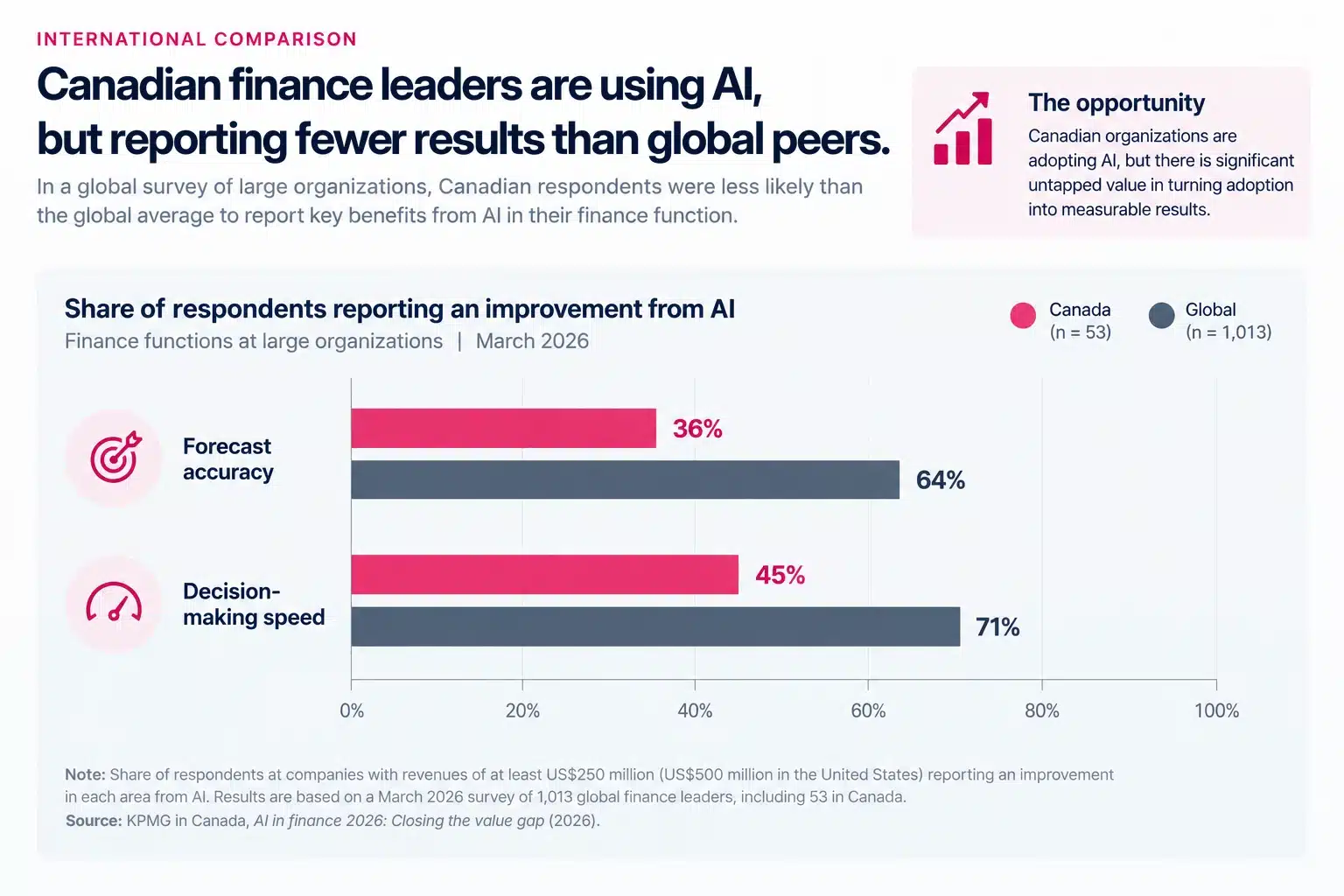
[25] KPMG in Canada. AI in finance 2026: Closing the value gap, 2026. Consulting-sponsored online survey, completed in March 2026, of 1,013 C-suite and senior finance leaders, including 53 in Canada, at companies with annual revenues of at least US$250 million (US$500 million in the United States). Supports Figure 2. The Canadian subsample is small and findings are self-reported.